E-Reader vs Physical Book: Which Is Better? (November 2026)
Pick an e-reader for a large library, travel and cheap long-form reading; pick physical books for collecting, gifting and distraction-free page turning. For most heavy readers the e reader vs physical book decision comes down to how many titles you read a year and how much shelf space you have.
On this page (8 sections)
Pick an e-reader for a large library, travel and cheap long-form reading; pick physical books for collecting, gifting and distraction-free page turning. For most heavy readers the e reader vs physical book decision comes down to how many titles you read a year and how much shelf space you have.
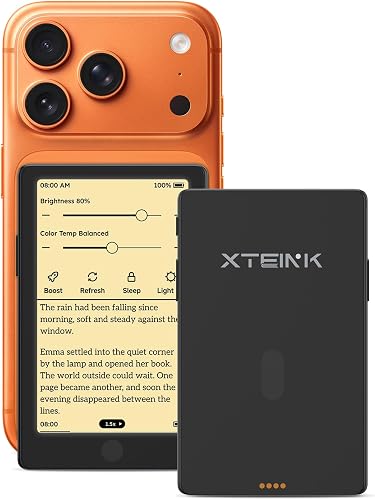
This comparison looks at what each format actually gives you. The e-reader side uses the Xteink X4 Pro and X3, two compact E-Ink readers sold at different sizes and prices.
The paper side uses two very different physical books: a study workbook and a large illustrated reference.
Neither format wins everywhere. Read on for the points that decide it.
E-reader vs physical book at a glance
The e-reader wins on portability and library size; the physical book wins on study, gifting and shelf presence. The table below sets the two formats side by side on the things that matter most.
| Point | E-reader (X4 Pro or X3) | Physical book |
|---|---|---|
| Titles carried | Thousands on 16 GB, more with a card | One per copy |
| Weight | 2.5 oz (X4 Pro) or 58 g (X3) | 2.31 lb to 5.28 lb for the two books here |
| Night reading | X4 Pro has a warm front light; X3 needs a lamp | Needs a lamp |
| Notes and study | Digital highlights and search | Color, write and quiz in the margins |
| Gifting | Needs the right device and account | Wraps and gives in one step |
| Distractions | None on either Xteink | None |
| Battery | Weeks on X4 Pro, up to 10 hours on X3 | None needed |

The format comparison is simple. An e-reader replaces the stack of books you would otherwise carry.
A physical book replaces nothing, but it does a few jobs better than any screen.
For a closer look at how e-readers compare with tablets, the e reader vs tablet breakdown covers the screen and app differences.
How much do you read and where?
The more you read and the more you travel, the stronger the case for an e-reader. A reader who finishes two books a month and commutes by train gets more from one device than from two hardbacks in a bag.
An e-reader holds thousands of titles in a body that weighs less than a paperback. The X4 Pro is 2.5 ounces and 5.95 mm thin, while the X3 is about 58 g and 5.1 mm thick.
Either one slips into a jacket pocket or a bag side pouch.
Physical books scale with each title. The HUNGRY MINDS book weighs 5.28 pounds and measures 9 x 2 x 12 inches.
Carrying that on a commute is a different decision from carrying the X3.
If you read mostly at home in one chair, the portability advantage shrinks. That is when the physical book's other strengths start to count.
When the e-reader wins on reading volume
People who read a lot tend to run out of shelf space before they run out of appetite for books. A single e-reader with a 16 GB library covers years of novels, and both Xteink models accept a microSD card up to 256 GB for comics and PDFs.
Replacing a finished book also costs nothing in weight. You tap the next title instead of adding another object to your bag.
The Kindle Paperwhite vs Signature Edition comparison shows how the bigger Kindle options handle that same trade-off.
When the physical book wins on place
A book you read in one spot, slowly, with a pencil in hand, doesn't need to be portable. The Anatomy Coloring Book is 8.38 x 1 x 10.88 inches and 384 pages, built to lie open on a desk while you color and quiz yourself.
A 4.3-inch screen doesn't do that job.
The same goes for the HUNGRY MINDS reference. Its 9 x 12 inch pages and detailed drawings reward browsing on a table, not swiping on a small screen.
Both books are at home on a desk or coffee table, and that is where they should stay.
Screen size and reading comfort
Bigger screens suit reference and comics; smaller ones suit novels and pockets. The two formats handle this differently, and so do the two e-readers.
The X4 Pro has a 4.3-inch E-Ink screen with a dual-tone front light. Warm and cool settings let you read in bright sun or in bed without a lamp.
The display is etched glass with an anti-fingerprint finish, so it stays clear under your thumb.
The X3 has a 3.7-inch E-Ink screen and no front light. Xteink says the missing light keeps the body ultra-thin and the display paper-like.
In practice that means you read it in daylight or with a lamp nearby.
Physical books set their own size. The Anatomy Coloring Book gives you a full page per illustration with a description opposite.
The HUNGRY MINDS book spreads drawings across 9 x 12 inch pages. Neither asks you to pinch or zoom.
Which e-reader screen fits your reading?
Pick the X4 Pro if you read at night, in bed or on long flights. The front light is the feature that separates it from the X3, and it is the one you notice most after dark.
Pick the X3 if you read in daylight and want the smallest possible device. It is a pocket reader for commutes and short breaks, and its size is the point.
Library size, storage and ownership
An e-reader gives you a library in one hand; a physical book gives you one title you own outright. The difference matters more than the spec sheet suggests.
Both Xteink models carry 16 GB of built-in storage. That is room for thousands of text-only books.
The X4 Pro and X3 each take a microSD card up to 256 GB for comics, PDFs and photos.
The ownership question is the real split. A physical book is yours to lend, resell or leave on a shelf for a decade.
An e-reader library lives on the device and depends on the files being DRM-free and compatible.
That last point matters with these two readers. Xteink states plainly that neither the X4 Pro nor the X3 supports DRM-protected books from Kindle, Libby and similar platforms.
Only DRM-free EPUB, MOBI, PDF and TXT files transfer and read.
Check your file format before you buy an e-reader
If your library lives in the Kindle store or comes through Libby, these Xteink readers will not open those files. A Kindle device or the Kindle app is the better fit for that library.
If your books are DRM-free EPUBs, PDFs or text files, either Xteink reader handles them. Our guide on how to transfer books to a Kindle covers the file side for Kindle owners, and the same format thinking applies here.
What physical books do that files cannot
A physical book survives a dead battery, a lost account and a changed platform. The Anatomy Coloring Book stays usable for as long as the paper holds, and its quiz answer keys sit on the same page.
The HUNGRY MINDS book has a second life as decor. Its 400 pages and hardcover build make it a table book you can leave out.
A file cannot do that.
Study, notes and highlighting
Physical workbooks win for active study; e-readers win for searching and carrying reference text. The Anatomy Coloring Book is the clearest case in this comparison.
It packs more than 450 realistic medical illustrations across 384 pages. Each illustration has a description opposite it, key terms in bold, and a self-quiz with same-page answers.
The pages are laid out with no back-to-back images, so coloring does not bleed through.
That combination needs paper. You color, you write, you cover an answer with your hand.
Kaplan built the Tenth edition for pre-health students, and the format is the method.
An e-reader is better for looking things up. Both Xteink models support EPUB, TXT, MOBI and PDF, so you can carry a textbook or a manual and search it.
The X4 Pro adds touch and gesture control plus physical page buttons. Neither device supports third-party apps, so study tools live outside the reader.
Pick the format that matches your study habit
If you learn by doing, marking and coloring, buy the physical workbook. If you learn by searching and reading on the move, put the reference file on an e-reader.
Battery, charging and daily upkeep
An e-reader needs charging now and then; a physical book needs nothing. The gap in convenience is small but real over a year of reading.
Xteink says the X4 Pro runs for weeks on a single charge from its 1100 mAh battery. The X3 gives up to 10 hours of reading, or about a week of casual use, and charges through a magnetic pogo-pin connection.
A physical book has no battery, no cable and no firmware update. That is a genuine advantage for a book you pick up once a month.
It also means the Anatomy Coloring Book and the HUNGRY MINDS book will still work in twenty years.
The trade-off is weight. The X4 Pro is 2.5 ounces and the X3 about 58 g, so neither adds meaningful load to a bag.
A 5.28-pound reference book does.
Setup and upkeep for each format
The X4 Pro connects over Wi-Fi and moves books through the Xteink app. It supports EPUB, TXT, MOBI and PDF.
If a system update fails, Xteink's guidance is to press reset, hold power to restart, then retry on a stronger network.
The X3 supports DRM-free EPUB and TXT files, and transfers over Wi-Fi, its own hotspot, a microSD card or the Xteink app. Its 2.4 GHz Wi-Fi only, so a 5 GHz-only router needs compatibility mode or a hotspot.
Physical books skip all of that. Open the cover and read.
Which format suits your reading year?
Choose an e-reader if you finish more than a book or two a month and want to carry them all; choose physical books for study, gifts and a shelf you enjoy looking at. The decision usually comes down to volume and setting.
Go with an e-reader if most of your reading is novels, you travel or commute, and your files are DRM-free. The X4 Pro is the easier pick for night reading and touch control.
The X3 is the better fit if you want the lightest possible pocket device and read in daylight.
Stay with physical books if your reading is tied to a desk. The Anatomy Coloring Book needs paper to work as a study tool.
The HUNGRY MINDS book needs a table to be browsed and shared.
Many readers end up with both. An e-reader for the everyday stack and a few paper books for study and display is a common split, and it covers the weaknesses of each format.
Who should buy the Xteink X4 Pro?
The X4 Pro suits readers who want one device for day and night. Its dual-tone front light covers a bedside read and a sunny park bench, and its touchscreen plus side buttons let you turn pages either way.
It also suits anyone with a mixed library of EPUBs, PDFs and comics, since 16 GB plus a microSD slot up to 256 GB covers a lot of files. Check that your books are DRM-free first.
Who should buy the Xteink X3?
The X3 suits commuters and short-break readers who want a reader that disappears into a pocket. At about 58 g and 5.1 mm thin, it is the smallest option in this comparison.
It is also the simpler device. With no front light and no third-party apps, it does one job in daylight.
Pair it with a reading lamp at home.
Who should buy the Anatomy Coloring Book?
Pre-health students and anyone learning anatomy by hand should buy the physical copy. The Tenth edition gives you 450+ illustrations, bold key terms and self-quizzes with same-page answers.
Coloring is the study method, and the page design supports it.
Who should buy the HUNGRY MINDS book?
Buy it as a gift or a table book for a curious household. Its 400 pages cover medicine, materials, mechanisms and farming, and its size makes it easy to browse with someone else.
It also reads well with children, since the format invites questions.
E reader vs physical book: the verdict
For most readers who read often, an e-reader is the better buy, and the Xteink X4 Pro is the pick because its front light and touchscreen cover more situations. Its 7.9 score edges the X3's 7.3 on features you notice every day: night reading and easier page turns.
A physical book still wins for specific jobs. The Anatomy Coloring Book (9.3) is the best study format here, and the HUNGRY MINDS book (9.1) is the best for display and gifting.
Those high scores reflect how well each does its own job, not how they compete with a reader.
The simple rule: if your reading is volume and travel, buy an e-reader. If your reading is study or collecting, buy paper.
If you read a lot of DRM-free files and also want a small travel device, the Kobo e-reader vs Kindle Paperwhite comparison is worth a look before you commit to a platform.
Frequently asked questions
Is an e-reader cheaper than buying physical books?
An e-reader costs more up front, but digital titles are usually cheaper per book and library loans are free. If you read more than a couple of books a month, the savings often cover the device within a year.
Can an e-reader read DRM-protected Kindle books?
Kindle e-readers read Kindle DRM files, but the Xteink X4 Pro and X3 do not support DRM-protected books from Kindle or Libby. Check the format before you buy if your library lives in the Kindle store.
Do e-readers hurt your eyes more than paper?
E-Ink screens reflect light like paper and do not use a backlight in normal daylight, so many readers find them easier on the eyes than a phone or tablet. The X4 Pro adds a warm front light for reading in the dark.
How many books fit in 16 GB on an e-reader?
Sixteen gigabytes holds thousands of text-only books, since a typical novel takes under a megabyte. Comics and PDFs take far more room, which is why the X4 Pro and X3 both accept a microSD card up to 256 GB.
Can you take notes or highlight in a physical book?
Yes, with a pen or highlighter, though it marks the page permanently. E-readers highlight and search digitally, but the X3 and X4 Pro are reading devices first, so check the note features before you rely on them for study.